
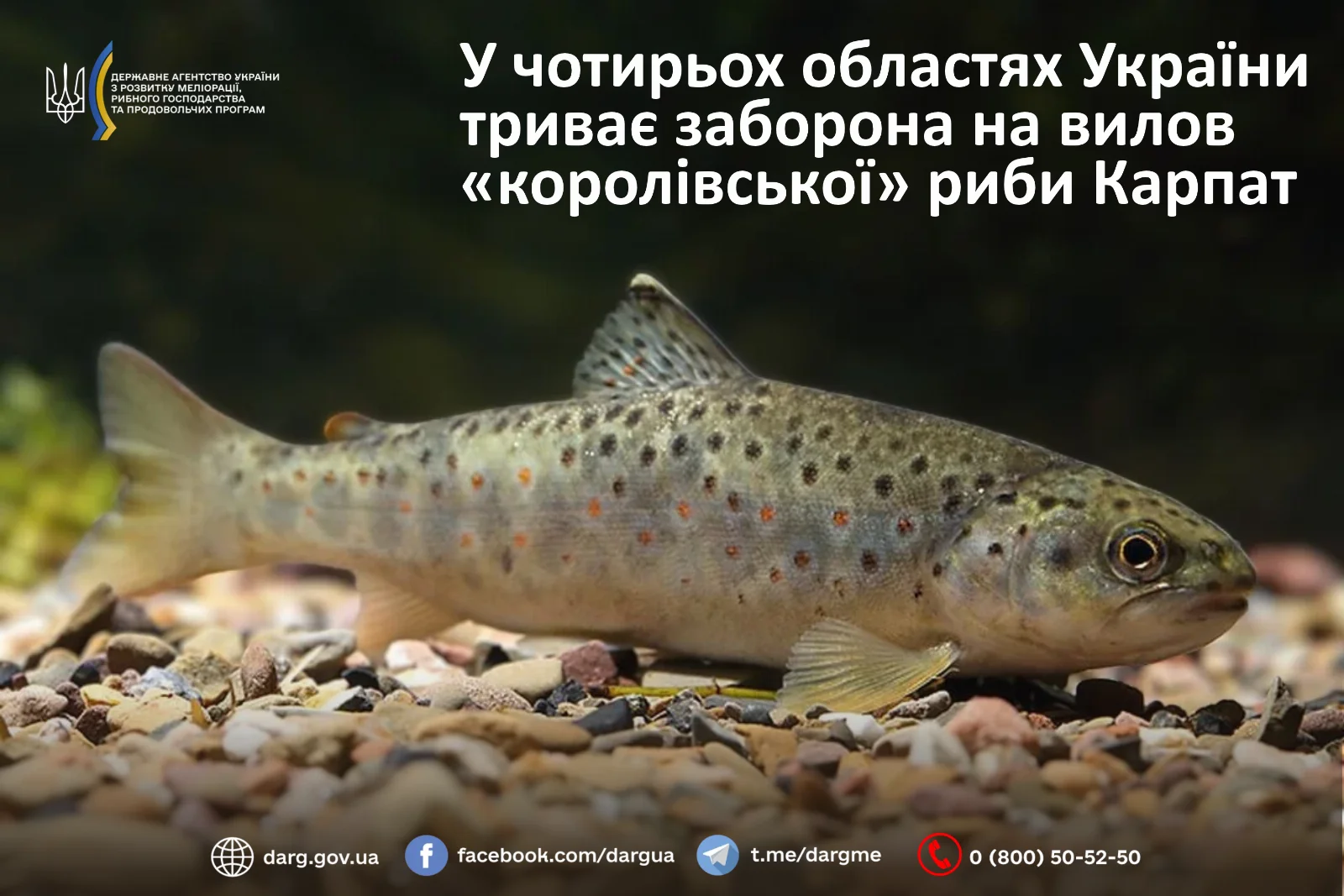
Dear anglers! We remind you that until 1 March 2027, a spawning ban on catching brown trout – an indigenous salmonid species – is in effect in the mountain rivers of the Zakarpattia, Ivano-Frankivsk, Lviv and Chernivtsi regions.
“During the spawning period, trout becomes especially vulnerable. The powerful instinct to reproduce suppresses self‑preservation reflexes, and the fish can become easy prey for poachers. Therefore I call on anglers to treat spawning trout responsibly and to adhere to the established limits for successful fish population reproduction,” noted the head of the State Fisheries Agency Ihor Klymenok.
Spawning of brown trout is a complex natural process that requires special environmental conditions. It usually begins in October, but the exact timing depends on weather conditions and water temperature. One of the key signals for the start of the spawning migration is a temperature drop to about 6–8 °C.
Successful trout reproduction requires certain natural conditions:
Clean, cold water. Trout belongs to cold‑water fish species and is sensitive to pollution and rising water temperature. The most favorable temperature for spawning is up to 10 °C.
High dissolved oxygen content. Normal egg development requires well‑oxygenated water, typical of fast‑flowing mountain streams.
Fast current and suitable substrate. For egg deposition the fish selects river sections with flowing water and mainly a gravel or rocky bottom.
Guided by the instinct to reproduce, trout can travel considerable distances against the current, heading toward river headwaters and their tributaries. During the spawning migration it overcomes various natural obstacles, including small waterfalls.
The egg‑laying process has its particularities. The female selects a suitable spot and, using her tail fin, stirs the gravel to create a depression – a kind of spawning nest. She deposits the eggs there, which are fertilized by a male or several males.
The fecundity of brown trout is relatively low: depending on size and age, an adult female can lay from a few hundred to several thousand eggs. After fertilization she covers the clutch with fine gravel, forming a protective layer that shields the eggs from predators and mechanical damage while also allowing oxygen‑rich water to flow through.
Embryo development beneath the gravel layer continues throughout winter. This is a prolonged and vulnerable stage of the trout’s life cycle, as part of the eggs may perish due to natural factors. The larvae begin to hatch only in spring, usually in April–May.
Source: State Fisheries Agency. Original date: 12.11.2026. CC BY 4.0. Layout adapted.