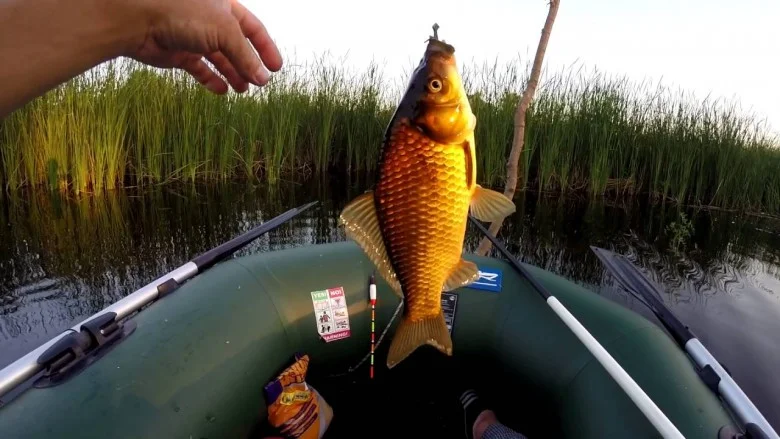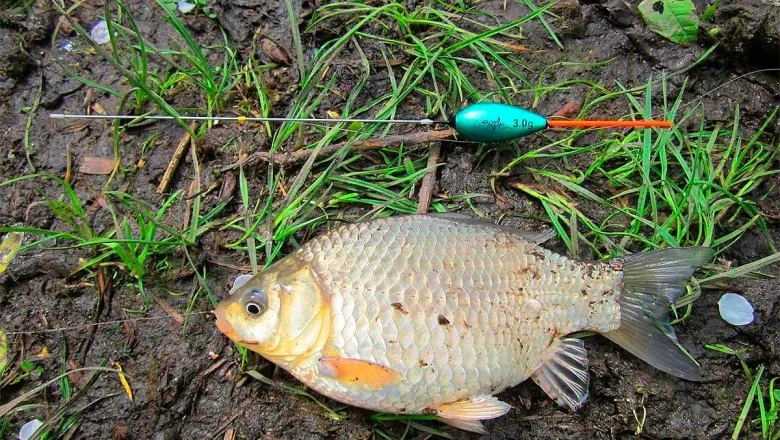
Choosing and setting up a float rod for crucian carp
Thus, a rich catch will be ensured if the tackle is responsibly assembled. For crucian carp, a pole, match rod, or telescopic whip will work. The rod is selected according to the water body conditions and fishing circumstances.
If you plan to fish for crucian carp at a distance of 2–3 m from the shore, for example among reeds and other shoreline vegetation, a telescopic whip up to four metres long is preferable. Main requirements for a float rod for crucian carp:
- main line diameter 0.18–0.2 mm, with a breaking strain up to 4 kg;
- rod length 4–6 m (choice depends on fishing conditions);
- leader up to 30 cm made of line 0.15 mm in diameter;
- elongated float with a thin antenna 4–6 cm long;
- hooks with short shank, dark colour, size 3–4; special attention should be given to the sharpness of the point.
Choosing a fishing spot
Crucian carp can be successfully caught with a float rod on almost any part of a water body. It inhabits small rivers and ponds, lakes and reservoirs. It is most often found in areas where the depth does not exceed three metres. The most convenient way to fish for crucian carp with float tackle is on still‑water bodies. Note that a moving bait attracts crucian carp less than bait that remains motionless.
Finding active crucian carp carp is the angler’s primary task. Therefore, the most promising spots for this fish are those with underwater vegetation and the edges near duckweed and reeds. Here the crucian carp will always feed, provided the weather is good. Preferring deep spots is not recommended, as crucian carp feed at depths of 1–2 m among lily pads and young rushes.
Crucian carp also occurs in shallow bays with soft or clay bottoms. Thus, if such a spot, whose surface is heavily covered with duckweed, has a small opening, you can confidently cast a bait into it, and if a school of crucian carp is nearby, you won’t have to wait long for a bite. Large crucian carp can be found in areas with sharp depth changes, so upon arriving at the water body, it is advisable to first study the bottom relief of the chosen area.
In mid‑summer, when the days become hot and the water in the shallows heats up more intensely, crucian carp start looking for spots where the water is enriched with oxygen. Promising places include shaded sections of the bank, under bridge supports, and near trees that have fallen into the water. In summer you can fish for crucian carp not only from the shore but also from a boat. The latter option is preferable because it allows easy access to the most remote and most promising fishing areas.
In small closed water bodies crucian carp hardly change their habitat, so knowing where they are usually caught well, you can confidently return to those spots and the bite will be guaranteed. Additional clues to the presence of active crucian carp can be rising bubbles, movement of reeds or grass.
Float-rod fishing technique
When you arrive at the water and choose a spot, it must be ground‑baited immediately with a small amount of groundbait that must contain a portion of the bait you will use. It is enough to toss 2‑3 lumps of groundbait about the size of a tennis ball into the water. Today you can buy crucian groundbait in a tackle shop or make it yourself. It is recommended to mix the groundbait on the shore using local water. If you decide to use store‑bought groundbait, add, at your choice:
- corn, semolina, or wheat grain;
- bread crumbs;
- ground sunflower seeds or meal;
- cookies or gingerbread;
- honey, sugar;
- bloodworms, maggots or manure worms.
Using any of the suggested ingredients will increase the attractiveness and effectiveness not only of homemade groundbait but also of the one purchased in a tackle shop.
Only after the fishing spot has been ground‑baited can you start setting up and laying out the gear. Note that crucian feed from the bottom, so you need to set the depth so that after the cast the float stands vertically while the hook with the bait rests freely on the bottom.
Two float rods are sufficient for fishing; after casting they are placed on the rod holders and wait for a bite. Keep in mind that if after 30 minutes the crucian does not start biting, throw a couple more groundbait balls into the fishing point, specifically between the floats, landing about half a metre short of them.
When planning a crucian fishing trip, you should have at least five different types of bait. Note that in spring and autumn crucian bite better on animal‑based baits (bloodworms, worms, burdock larvae, maggots), while in summer they also accept bread, dough, or pearl barley. With a wide assortment of baits you can experiment and quickly find the option that the crucian is most attracted to today.
Crucian carp bites are slow and delicate; the float may move a few times, then it slowly begins to tilt to the side or dip under the water and suddenly darts away. The hook‑set must be made promptly; if the float returns to its original position, all that remains is to pull out the gear, attach the bait to the hook and cast it again.
At the moment of the bite you should make a short, sharp hook‑set. Once on the hook, the crucian fights hard but only briefly. Large crucians are best lifted out of the water with a net.
Tips and recommendations from specialists
With basic crucian carp fishing skills you can always expect to catch a few decent specimens. However, achieving consistent bites requires effort. The following tips will help increase the number of bites and guarantee a plentiful catch:
- When rigging the tackle, try to use as few weights as possible. At the moment of the bite the crucian becomes more cautious, and if it feels resistance or tension in the rig, it will immediately try to spit out the bait.
- If the rig has two hooklengths simultaneously, make them different lengths; this will prevent them from overlapping and will increase the number of bites.
- The weight should be divided into three pieces from smallest to largest. The weights are placed on the main line at 10 cm intervals.
- For the main line use the smallest possible diameter and choose the colour that matches the conditions. If you fish among underwater vegetation, a green line is advisable; for clear water sections a white line works, and for sandy bottoms a yellow line is best.
- Your chances of success will rise significantly if you use groundbait that contains one-third of the bait used for fishing.
In conclusion, when planning a crucian carp fishing trip don’t overlook the basics. For example, camouflage. Try to stay as quiet as possible on the bank, avoid getting close to the water’s edge, keep noise down, and most importantly, don’t wear bright clothing.