
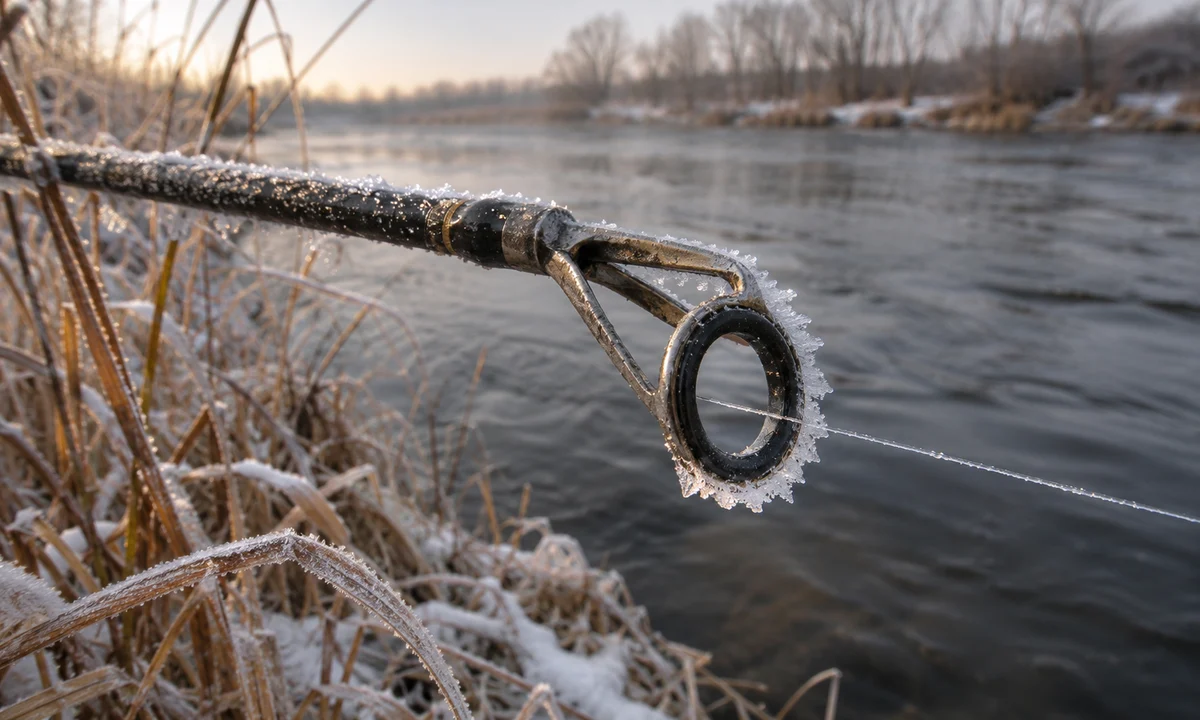
Your casts suddenly become shorter, the braid sounds rough and the lure judders during the retrieve. Before blaming the reel, check the tip: a small bridge of ice may already be blocking a guide. This is a familiar winter problem, but a forceful cast can turn a nuisance into damaged tackle. Here is a practical sequence for fishing from an open-water bank.
Stop rather than pulling harder
Wet line carries water into the guides, where it freezes in cold air. Small tip guides are particularly easy to obstruct as the opening gradually narrows. If the retrieve becomes uneven or the line makes an unfamiliar scraping sound, stop winding and inspect the outfit.
Do not try to punch through the blockage with the lure or a taut line. Release the tension first, secure exposed hooks away from your hands and make sure you are standing on a stable dry bank. There is no need to lean out over the water to thaw the rod.
Free the guides without forcing them
Pause and allow the ice to thaw without mechanical force. If a safe warm building is available nearby, finishing the short session and thawing the tackle there is an option. Do not chip ice away with a knife, pliers or a forcefully applied fingernail: a thin frame and a delicate guide insert lie underneath.
Avoid a lighter, boiling water or a hot hairdryer. Once the ice has thawed, gently remove water with a soft cloth, inspect the inserts and check that the line runs freely. A damaged braid or cracked guide is a reason to stop using that outfit.
Prepare before the first cast
Inspect clean dry guides at home. Apply a purpose-made anti-icing treatment only according to its instructions and after checking compatibility with your line, guide inserts and rod finish. Such a treatment may reduce ice buildup; it does not make an outfit immune to freezing.
Do not substitute automotive antifreeze, household lubricant or an unverified aerosol. Fish a distance you can comfortably control: a long wet length of line and repeated casting add to the task. Inspect the tip regularly instead of waiting for the lure to stop moving.
Would switching to monofilament help?
Smooth monofilament can be easier to handle in some freezing conditions, but switching changes stretch and bite transmission. It is not a universal cure for frozen guides. Winter braids also vary in coating, wear and behaviour once wet.
Before the trip, check the knot, drag and suitability of the line for your lure. Avoid rebuilding the entire outfit in the middle of a difficult session. If ice returns after every retrieve, a milder day or an early finish may be the better choice.
A quick check before continuing
Clear guides, freely running line, secured hooks and fingers that still feel what they are doing are a reasonable basis for a gentle trial cast. Sudden movements do not compensate for cold conditions. A slippery bank or awkward approach matters more than a promising fishing spot.
Check local access and seasonal fishing restrictions before travelling. This article concerns an open-water bank, not venturing onto ice. The aim is simple: make a few controlled retrieves and bring the tackle home intact.