
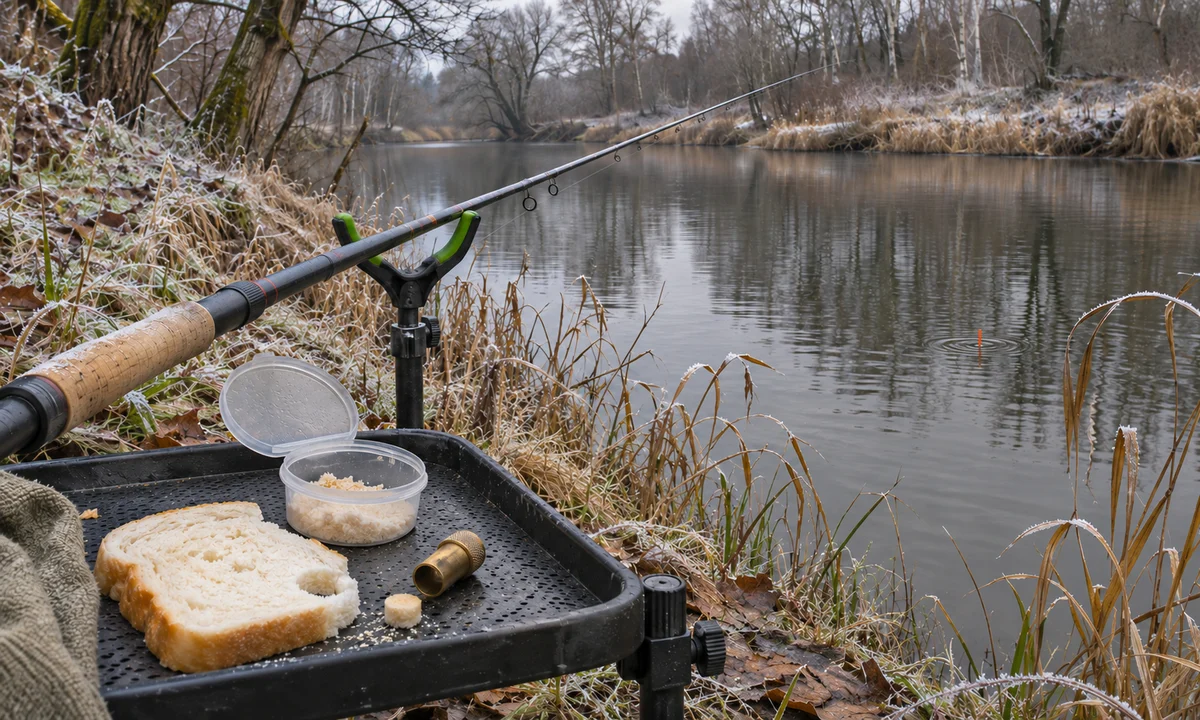
While the water remains open, a winter fishing trip does not have to involve ice holes and an auger. A float rod, a few slices of soft bread and a familiar stretch of bank can offer an absorbing session. The interesting details are small ones: whether the bait stays on, where the hook travels and what changes after a modest amount of feed.
Start with a permitted, accessible bank
Choose somewhere you can stand securely and use a landing net: a gentler strip beside the main flow or a familiar reach offering a controlled float run. Plumb the depth rather than guessing from dark water. The deepest point is not automatically the best.
In Ukraine, check current boundaries of designated wintering areas and local restrictions. Advice to fish near a deep feature does not permit fishing inside a closed zone. Never step onto a thin ice edge to reach open water. Choose a short daylight window for a first session.
Keep bread usable as a hookbait
Take fresh soft bread without mould. A bread punch makes small discs of crumb; alternatively, carefully secure a small flake without squeezing the whole piece into a hard pellet. Keep the spare bread in a closed box so it does not dry out.
Match the hook and bait size together. Avoid burying the point in a dense lump. Test the bait beside the bank: does it survive lowering and gentle movement? If it falls off, adjust how you attach it and how you cast before reaching for flavourings.
Set the float for control
Your rod should let you manage the line, and the float should indicate a light signal while remaining visible in the available light. Distribute the shot so the hookbait reaches the working layer without uncontrolled drift. On moving water, check whether the rig is lifting the hook above the intended level.
Start by presenting close to the bottom and compare a small depth adjustment. If the float repeatedly disappears in one place without a fish, the hook may be catching the bottom. That interruption should not automatically be read as a delicate bite.
Feed in small steps
Introduce a small initial amount of fine bread feed to one identifiable area. Watch where the flow carries the particles and where your hookbait travels. Do not rush to add another portion simply because several runs produced nothing.
Keep observations simple: a signal appeared after feeding, contact came at a different depth or fish stopped responding. If the bait is intact and the presentation controlled, first change one detail: fishing depth, route or bait size. Bread is an option to test, not a catch guarantee.
Finish before you become too cold
Prepare a landing net, an unhooking tool and a dry hand cloth in advance. Do not put fish intended for release on snow or frozen ground. Remove discarded line, packaging and leftover food; leave no heap of bread on the bank.
Understanding one swim and one presentation is a worthwhile outcome from a short trip. Record water level, working depth, bait and the response to feed for next time. That small diary is more useful than a promise that roach always feed at a particular hour.